

Wind Generator Maintenance
Wind generator maintenance is one of the highest-leverage activities available to an O&M team. A turbine that loses output due to a degraded slip ring, a worn carbon brush, or a failing pitch control system does not fail visibly: it simply underperforms, runs hotter, and accumulates wear that compounds over time.
Understanding which electrical components require attention, at what intervals, and why they degrade in the first place is the starting point for any maintenance program that aims to protect availability and extend asset life.
-
This guide covers the main electrical systems involved in wind generator maintenance, the failure modes that matter most in practice, and the service approaches that Mersen's Windtracker wind services teams have developed across thousands of up-tower interventions on onshore fleet in the US and around the world.
-
Focus on
Why wind generator maintenance is different from standard industrial maintenance
Wind turbines present maintenance engineers with a set of constraints that have no equivalent in a conventional industrial plant.
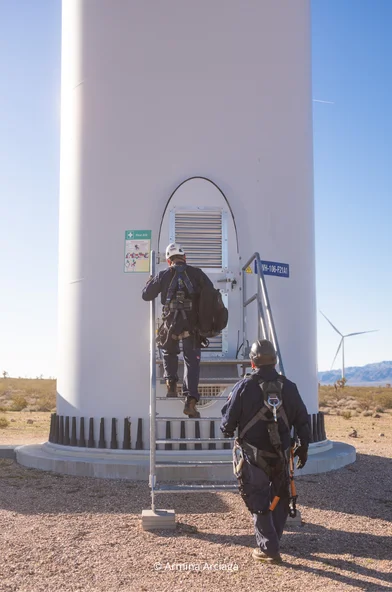
Access requires climbing to nacelle height, typically 60 to 100 meters, and the working space inside the nacelle is confined. Every component brought up for replacement or every tool used on-site carries a cost in technician time and tower access that is orders of magnitude higher than equivalent workshop work.
This changes the economics of maintenance decisions fundamentally. A carbon brush that can be replaced on the ground for a few minutes of labour requires a full up-tower mobilization in a turbine. A slip ring assembly that fails unexpectedly takes the turbine offline and triggers an emergency intervention at a premium cost. The result is that the twin objectives of wind generator maintenance are not simply 'fix what breaks' but rather extend service intervals as far as possible and eliminate unplanned failures entirely.
A secondary complication is environmental exposure. Nacelle temperatures range from sub-zero in cold-climate sites to over 50 degrees Celsius in summer, humidity is often high, and vibration from the drivetrain is continuous. Every electrical contact surface in the generator and hub accumulates contamination, oxidation, and mechanical stress that does not affect a component in a controlled factory environment.
-
The three electrical systems that drive wind generator maintenance frequency
Wind generator maintenance is primarily concerned with three rotating electrical systems, each with its own wear mechanisms, failure modes, and maintenance requirements.
1. Generator slip ring and carbon brush system
In a doubly-fed induction generator (DFIG), the slip ring assembly transfers rotor excitation current between the stationary power converter and the rotating winding. It is one of the highest-wear contact points in the machine. The slip ring surface accumulates carbon dust and oxidation products, brush pressure varies as brushes wear down, and heat builds up as contact quality degrades. Left unaddressed, this leads to a progressive increase in resistance, rising operating temperatures, NDE (Non-Drive End) bearing thermal faults, and eventually a flashover or complete brush failure.
Maintenance on this system involves brush inspection and replacement, slip ring surface cleaning and resurfacing, brush holder inspection, and terminal connection verification. The interval depends strongly on the brush grade and ring material: stainless steel rings with standard grades may require intervention every 12 to 18 months, while bronze rings paired with optimized grades can extend this to over four years between brush changes. See the dedicated page on
wind generator slip rings for a full comparison of ring materials and their maintenance implications.2. Pitch control slip ring system (hub slip ring)
The pitch control system relies on a signal and power transfer system (SPTS), also called a hub slip ring or pitch control slip ring, mounted in the hub to transfer both power and control signals between the stationary nacelle and the rotating hub. This system drives the pitch motors that adjust blade angle in response to wind speed, and it carries safety-critical signals: a failure here can prevent feathering and trigger an emergency stop.
Maintenance on the SPTS covers contact surface cleaning, carbon brush or wire contact inspection, seal integrity checks, and connection verification. Depending on the system, Mersen's SPTS units’ maintenance frequency may vary from once a year to every two years. Systems equipped with capacitive or fiber optic signal channels for data transmission are maintenance-free on those channels, but the power contacts that drive blade heating and pitch motor currents still require periodic inspection. Models such as the USDK656 for GE 1.5MW non-ESS, USDK686 for GE 1.5MW ESS, USDK704 for GE 2.X, and USDK729 for Suzlon S-64/S-88 are all designed with removable covers and accessible internal connections to minimize on-site intervention time.3. Grounding and surge protection system
The grounding brush system protects bearings from stray shaft currents and dissipates lightning-induced surges. These brushes are often overlooked in maintenance schedules because they have no direct production impact when they degrade gradually, but bearing damage from shaft currents is a well-documented and costly failure mode. For rotor shaft grounding systems, the contact surface should be checked and cleaned regularly. Several maintenance options are available, and some maintenance operations are straightforward: visual inspection, wear measurement, and replacement before the brush reaches its minimum length.
-
Wind generator maintenance intervals: a practical framework
There is no universal maintenance interval for wind generator electrical systems: the right interval depends on the specific components installed, the site's operating conditions, and the maintenance history of the individual turbine.
That said, the following framework is representative of what Mersen's field teams observe on the onshore fleet in the US and all over the world:
- biannual inspection (every 6 months): visual check of carbon brushes, hub slip ring contacts, and grounding brushes; cleaning of contact surfaces; verification of brush pressure
- annual inspection: full brush measurement and replacement decision, slip ring surface assessment, terminal connection torque check, seal inspection on SPTS units
- 2 to 4 year cycle (bronze ring systems): full brush replacement, slip ring resurfacing or replacement assessment, bearing temperature trend review
- event-driven: any sustained increase in slip ring temperature, increased electrical noise on pitch control signals, or WETA card faults triggers an unscheduled inspection ahead of the next planned visit.
In addition to this indicative maintenance program, offshore generator maintenance is generally planned once a year.
The goal of planned maintenance is to keep every intervention on the planned schedule and eliminate the event-driven category. The operational data consistently shows that turbines maintained on a structured program with optimized components spend significantly less total time offline than those managed reactively. Mersen also provides dedicated cleaning materials for generator and SPTS maintenance operations.
-
Wind maintenance program
Mersen Windtracker®: a wind generator maintenance program built for your performance in the US and worldwide
Mersen's on-site wind maintenance services are delivered under the Windtracker® program, a dedicated wind service offering built specifically for onshore fleets. Windtracker® teams are subject matter experts in signal and power transfer systems, with deep knowledge of carbon brush tribology, AC generator maintenance, DC pitch motor systems, and lightning protection.
The Windtracker® service follows an 8-step methodology: complete field diagnosis, reporting to the R&D team, solution engineering, installation and commissioning of upgraded components, and follow-up monitoring. The approach is designed to resolve the technical root cause of a maintenance problem rather than simply replacing worn parts on a schedule. It is also designed for up-tower efficiency: every intervention is prepared with the correct spares, tools, and documentation to minimize turbine downtime.
Services covered by the Windtracker® program include:
- carbon brush replacement on generator slip-ring assemblies
- slip ring assembly clean-out and generator slip ring resurfacing
- hub slip ring inspection, cleaning, and brush or contact replacement
- brush-holder inspection and replacement
- grounding brush inspection and replacement
- retrofit installation of upgraded components, including bronze slip rings and optimized brush grades
- technical diagnostics and root cause analysis for recurring fault patterns
For maintenance teams looking to build internal capability, Mersen also offers wind turbine generator training covering brush and brush holder maintenance, slip ring care, pitch control system servicing, and fault diagnosis. The program is available on-site and at Mersen facilities.
-
Frequently Asked Questions
On Wind generator maintenance
-
How often should wind generator carbon brushes be replaced?
Replacement intervals depend on several factors, including turbine operating conditions, location, onshore or offshore environment, carbon brush grade, and slip ring material. While time alone does not determine the replacement interval, general timeframes can still serve as useful reference points. On stainless steel rings with standard grades, replacement intervals of 12 to 18 months are common on the fleet in the US and all over the world. On bronze slip rings with optimized grades such as CG677 or CG626, intervals of three to four years are achievable. The most reliable approach is to track brush wear length at each inspection and establish a site-specific replacement trigger based on measured wear rate rather than a fixed calendar interval.
-
What are the most common wind generator electrical failures?
In field experience across the US onshore fleet, the most frequent electrical failure causes are: worn or seized carbon brushes causing increased rotor circuit resistance and temperature rise; contaminated or corroded slip ring surfaces reducing contact quality; pitch control system faults caused by degraded contacts in the hub slip ring; and bearing damage from stray shaft currents not adequately dissipated by the grounding brush. Most of these failures are detectable well in advance through temperature monitoring and regular visual inspection.
-
What is the difference between a generator slip ring and a pitch control slip ring?
A generator slip ring carries high rotor excitation currents (typically 400V to 690V, 30A to 100A depending on the platform) between the power converter and the rotor winding. A pitch control slip ring, or hub slip ring, carries lower power levels to the pitch motors and blade heating circuits, plus control signals and data between the nacelle controller and the hub electronics. They are physically separate systems with different maintenance requirements, though both use carbon brush contacts as the primary wear element.
-
Can Mersen service turbine brands other than GE?
Yes. Mersen's Windtracker service teams have experience across the main platforms operating in the US fleet, including GE 1.5MW and 2.X series, Vestas, Siemens, Suzlon, and Gamesa models. The component range covers OEM-specific SPTS units for GE non-ESS and ESS, Suzlon S-64/S-88, and Gamesa 8.X/9.X platforms, as well as application-engineered solutions for other turbine architectures. Contact Mersen's PTT North America team in Boonton, NJ for platform-specific availability.
-
How does planned wind generator maintenance affect turbine availability?
The relationship is direct and well-documented: turbines maintained on a structured preventive program consistently show higher availability than those managed reactively. The main drivers are that planned interventions are scheduled for low-wind periods, spares are pre-positioned, and intervention time is minimized through preparation. Reactive interventions triggered by unplanned failures carry premium costs in emergency mobilisation, often require waiting for parts, and frequently occur at high-wind periods when production losses are most expensive.
-

Products
Related Products


News
Related news

Tradeshows
Mersen at WindEurope Annual Event 2026
Learn more
Products
How to Reduce Carbon Brush Wear in Wind Turbines
Learn more
Products